How Established Companies Can Modernize Without Losing Their Legacy
Artificial intelligence is no longer an emerging trend, it is a defining force reshaping how businesses compete, operate, and grow. For leaders of traditional, long-established companies, AI presents a difficult but unavoidable reality:
Ignore it, and risk obsolescence.
Embrace it strategically, and unlock a new era of efficiency, insight, and growth.
This article is written for executives guiding legacy organizations through modernization, leaders who must balance innovation with stability, progress with culture, and speed with responsibility.
AI’s Dual Role: Competitive Threat and Strategic Opportunity

The Growing Threat to Traditional Businesses
AI-native competitors are entering markets with structural advantages:
- Faster decision cycles
- Lower operating costs
- Highly personalized customer experiences
Legacy organizations, built on decades-old systems and processes, often struggle to match this pace. Delayed adoption compounds risk: manual workflows, fragmented data, and intuition-based decisions simply cannot compete with AI-driven automation and predictive intelligence.
Across industries, early AI adopters consistently outperform late movers in revenue growth, operational efficiency, and customer satisfaction. The gap widens each quarter.
The Opportunity Hidden in Experience
Yet traditional businesses hold a powerful advantage: institutional knowledge.
Decades of customer insight, operational nuance, and domain expertise are invaluable, but only if they can be captured, structured, and amplified. AI enables organizations to turn historical data and human expertise into scalable intelligence, transforming experience into a competitive moat rather than a constraint.
When implemented correctly, AI delivers:
- 20–30% reductions in operational costs
- Faster, more confident decision-making
- New data-driven products and services
The opportunity is not to replace what made your company successful, but to extend it.
Who This Transformation Is For
This guide is designed for leaders of established organizations, typically companies with 30+ years of operating history, who face modernization challenges such as:
- Deeply embedded processes
- Legacy technology stacks
- Cultural resistance to change
It speaks directly to:
- CEOs defining long-term competitive strategy
- COOs modernizing operations and supply chains
- CIOs and CTOs responsible for scalable, secure systems
- Board members overseeing risk, governance, and ROI
If you are modernizing a legacy organization rather than building from scratch, AI transformation requires a fundamentally different approach.
Why AI Transformation Is Now Non-Negotiable
Several forces are converging simultaneously:
Customer Expectations Have Permanently Shifted
Customers now expect instant responses, personalization, and seamless digital interactions—standards that only AI-enabled systems can deliver at scale.
Operational Volatility Is the New Normal
Supply chain disruption, market uncertainty, and cost pressures demand predictive insight and real-time optimization.
Workforce Expectations Are Changing
Top talent expects modern tools. AI, when positioned as augmentation rather than replacement, improves productivity and job satisfaction.
Regulation Is Accelerating
AI governance, data privacy, and transparency requirements are expanding. Proactive, ethical AI adoption is now a leadership responsibility.
Assessing Your Readiness for AI
Before investing, leaders must understand their current position.
Key questions include:
- Where are we already using data—but not intelligence?
- Which processes are repetitive, slow, or error-prone?
- Where do decisions rely on hindsight instead of foresight?
High-impact AI opportunities often emerge in:
- Customer service and personalization
- Predictive maintenance and operations
- Demand forecasting and supply chain optimization
- Risk management and compliance
Quantifying these opportunities builds a credible, executive-level business case.
From Strategy to Execution: Why AI Requires More Than Tools
One of the most common mistakes legacy organizations make is treating AI as a software purchase rather than a transformation initiative.
True AI transformation requires:
- Business-aligned use-case design
- Secure, scalable architecture
- Strong governance and ethics frameworks
- Integration with existing systems and workflows
This is where partnering with specialists matters. Organizations increasingly rely on an TechIsland AI Development Service to design, build, and integrate AI solutions that align with real business objectives—not experimental technology showcases.
Rather than forcing one-size-fits-all platforms, this approach tailors AI models, data pipelines, and automation to the organization’s specific context, constraints, and goals.
Executive Alignment: The Real Make-or-Break Factor

AI initiatives fail far more often due to leadership misalignment than technical limitations.
Successful transformations are led from the top and characterized by:
- Shared understanding of AI’s role and limits
- Clear ownership and accountability
- Agreed-upon success metrics
- Regular governance and review cycles
Alignment does not require unanimous enthusiasm—but it does require unified commitment once decisions are made.
Scaling the Vision Across the Organization
Transformation succeeds when communication is tailored:
- Executives need strategic context and ROI logic
- Managers need clarity on implementation and priorities
- Frontline employees need reassurance, training, and purpose
Organizations that invest in workshops, internal pilots, and transparent communication consistently see higher adoption and lower resistance.
Managing Resistance Without Losing Momentum
Resistance is natural, especially in organizations shaped by decades of success.
Common concerns include:
- Fear of job displacement
- Anxiety over new skills
- Attachment to proven processes
- Fatigue from past change initiatives
The most effective leaders address these concerns directly by emphasizing reskilling, involving experienced employees in design, and delivering early, visible wins that prove value.
A Phased Path to Sustainable AI Transformation
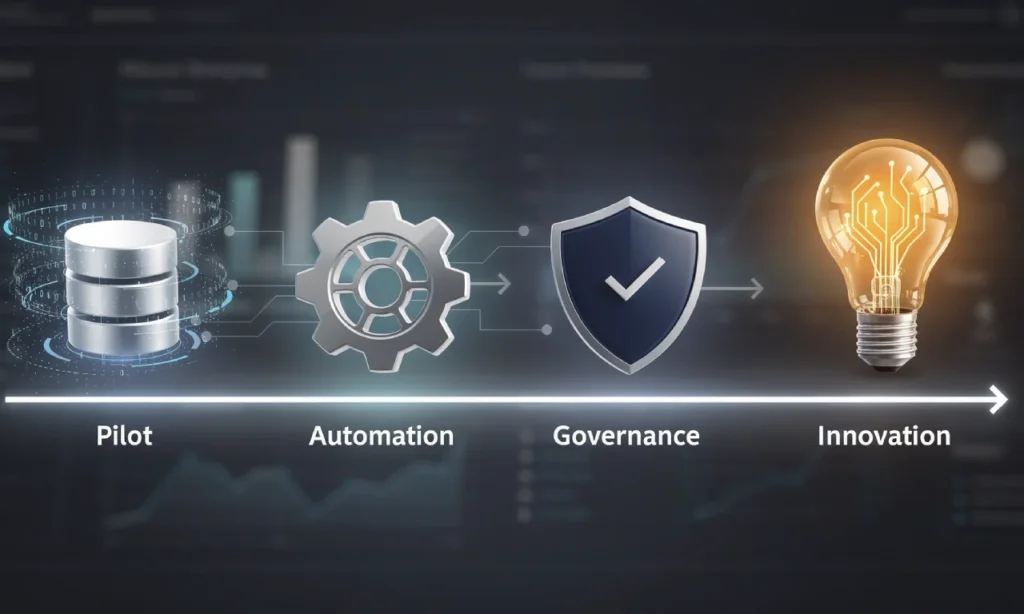
Rather than attempting wholesale change, successful organizations follow a phased approach:
- Discovery & Quick Wins – High-impact pilots that demonstrate ROI
- Foundation Building – Data, governance, and architecture readiness
- Scaled Deployment – Integration into core workflows
- Continuous Innovation – Ongoing optimization and exploration
This balance ensures progress without burnout or operational instability.
Conclusion: Leading AI Transformation Without Losing Who You Are
AI transformation is not about becoming a technology company.
It is about becoming a more intelligent version of your existing business.
For traditional organizations, the path forward is clear:
- Start with strategy, not tools
- Respect institutional knowledge
- Invest equally in people, process, and technology
- Move fast enough to stay competitive, but slow enough to stay sustainable
When paired with the right AI Development Service, legacy businesses can modernize confidently, unlocking efficiency, insight, and growth while preserving the culture and expertise that made them successful in the first place.
The future does not belong exclusively to startups.
It belongs to the leaders willing to evolve.