Still stuck at the whitepaper stage?
Every year, thousands of Web3 whitepapers are published.
Very few turn into real, usable products.
Most founders don’t fail because their ideas are weak. They fail because moving from a whitepaper to a functioning MVP is one of the most execution-heavy challenges in crypto. Smart contracts are unforgiving, timelines are unclear, security risks are high, and many teams overbuild long before they validate demand.
At TechIsland, we work with Web3 founders at this exact crossroads: strong vision, clear thesis, detailed documentation, but nothing users can actually interact with.
This article breaks down how founders can realistically go from idea → architecture → MVP → mainnet in 2025, without burning runway or compromising security.
Why most Web3 projects stall after the whitepaper
A whitepaper explains what you want to build, not how to build it.
Founders often underestimate how many unanswered questions remain after the whitepaper is finished:
- What is the smallest possible product that proves this idea works?
- Which components must be on-chain versus off-chain?
- What security tradeoffs are acceptable at the MVP stage?
- How long will development actually take?
- What will it really cost?
Without clear answers, teams fall into common traps.
Overbuilding too early
Many founders attempt to ship the full end-state vision immediately: multi-chain support, advanced tokenomics, complex governance, and edge-case features no users have asked for yet. The result is bloated scope, delayed launches, and missed market opportunities.
Treating smart contracts like traditional backend code
Smart contracts are immutable, adversarial, and directly exposed to financial risk. Poor architecture decisions or skipped audits don’t cause minor bugs, they create existential threats.
Confusing fundraising readiness with product readiness
In 2025, investors increasingly expect execution proof. A whitepaper may open doors, but a working MVP is what sustains momentum.
Step 1: Turn the whitepaper into a buildable architecture
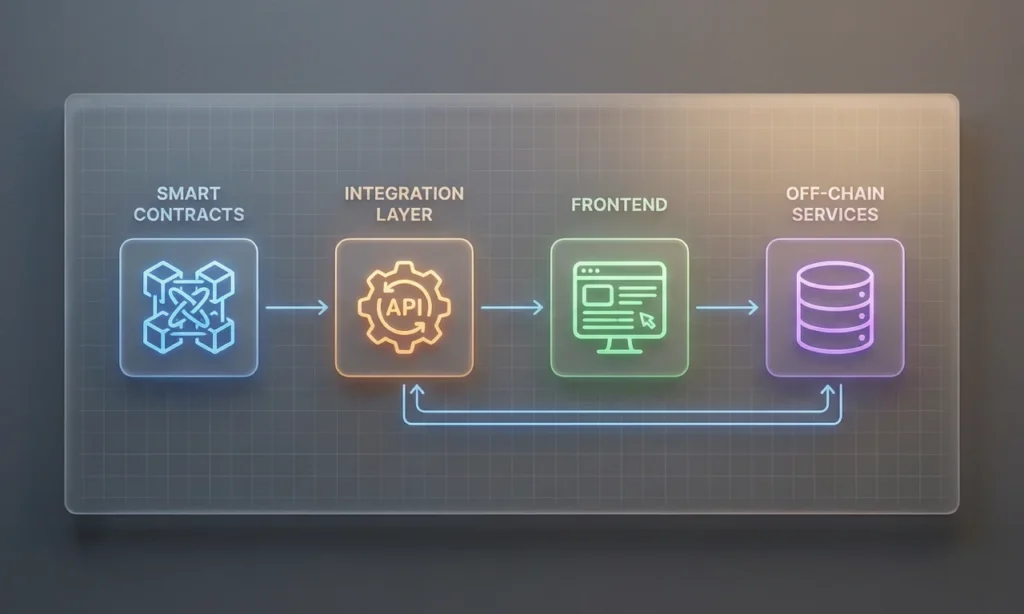
Before any code is written, founders need architectural clarity.
A practical way to translate a whitepaper into a real system is to break it into four layers:
- Smart contract layer – Core protocol logic, token contracts, treasury rules
- Integration layer – Oracles, bridges, external protocols
- Frontend layer – User interfaces and wallet interactions
- Off-chain components – Indexers, APIs, automation, databases
The guiding rule is simple: only trust-critical logic belongs on-chain.
Everything else should live off-chain to improve performance, reduce costs, and allow faster iteration. A clear architecture diagram at this stage prevents scope creep and becomes essential for developers, auditors, and investors.
This is also where experienced Blockchain Development Service teams add the most value, helping founders make early architectural decisions that won’t require expensive rewrites later.
Step 2: Define an MVP that actually validates something
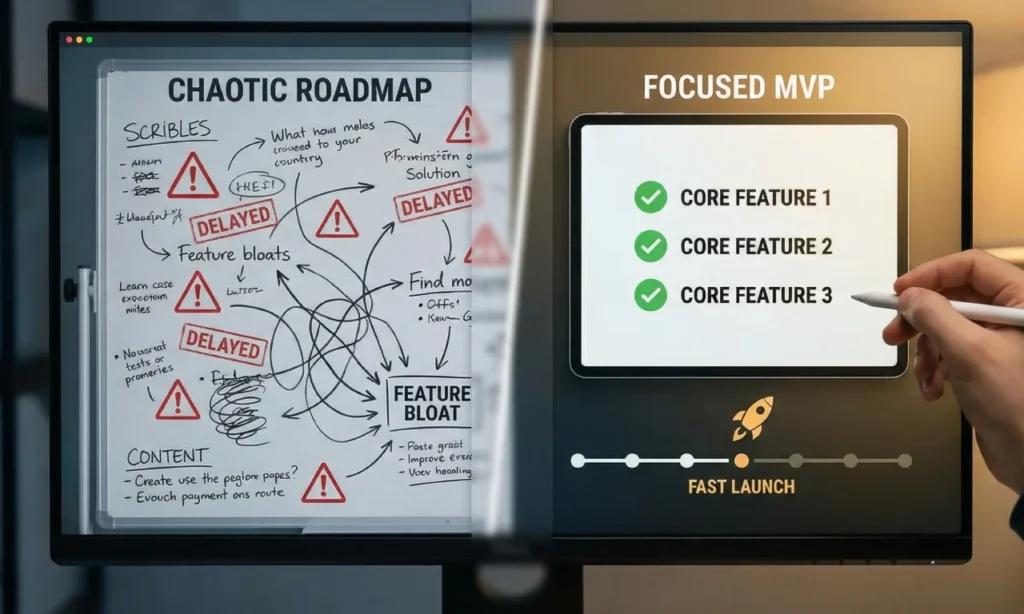
An MVP is not a smaller version of the final product.
It is the minimum system required to validate your riskiest assumption.
Founders should ask:
- What must work for this idea to be real?
- What can fail quickly without killing the company?
Practical MVP examples
DeFi MVP
- Core swap or lending logic
- Wallet connection
- One or two liquidity pairs
- Basic interface
NFT MVP
- Minting
- Metadata storage
- Fixed-price purchases
- Wallet gallery
DAO MVP
- Proposal creation
- Token-weighted voting
- Simple treasury visibility
Advanced analytics, complex governance, and multi-chain deployments can wait. Speed to market and learning matter more than completeness.
Step 3: Choose the right blockchain for now
Chain selection in 2025 is a practical decision, not a philosophical one.
Different chains serve different needs:
- Ethereum mainnet offers maximum security at higher cost
- Layer 2s provide Ethereum security with better economics
- Solana excels at high-throughput, low-latency use cases
- Polygon works well for consumer-facing applications
The biggest mistake founders make is trying to future-proof too early. You do not need to launch everywhere.
Choose the chain where your users already are and where your MVP can operate economically. Multi-chain expansion is a post-validation problem.
Step 4: Build smart contracts with security as the default

Founders don’t need to write Solidity, but they must understand smart contract fundamentals.
At the MVP stage, secure architecture means:
- Modular contracts with single responsibilities
- Role-based access control
- Reentrancy protection
- Emergency pause mechanisms
- Upgrade paths for critical logic
Battle-tested libraries like OpenZeppelin exist for a reason. Use them.
Security is not a one-time event. It includes testing, internal reviews, external audits, and post-launch monitoring. Budgeting 10–15% of development costs for audits is standard, not optional.
Step 5: Token utility must justify the token
Tokens fail when they exist without purpose.
A strong token model clearly answers one question:
Why does this product need a token at all?
Valid utility models include:
- Access to features or reduced fees
- Staking for security or alignment
- Governance with real authority
- Value capture linked to protocol usage
Common failures include inflationary emissions with no demand, large vesting cliffs, and governance tokens with no meaningful power.
The best token designs create flywheels where product success drives token demand, and token demand reinforces product growth.
Step 6: UX is the real adoption bottleneck
Most users don’t leave Web3 products because of gas fees.
They leave because the experience feels confusing or unsafe.
Strong MVPs focus on:
- Demonstrating value before wallet connection
- Clear transaction previews
- Plain language instead of jargon
- Helpful errors and confirmations
- Mobile-first design
Making a user’s first on-chain interaction feel understandable and safe is a major competitive advantage.
Step 7: The mistakes that kill most Web3 MVPs
Across cycles, the same patterns repeat:
- Overbuilding before validation
- Delaying security reviews
- Ignoring community until launch
- Designing for insiders instead of users
- Treating feedback as noise instead of signal
A major warning sign is a roadmap that keeps expanding while the launch date keeps slipping.
Progress beats perfection.
Conclusion: From whitepaper to real product
In 2025, Web3 rewards founders who execute.
Not the most elegant whitepaper.
Not the most complex token model.
The teams that win are the ones who scope ruthlessly, build securely, launch early, and learn fast.
Turning a whitepaper into a real MVP requires disciplined architecture, focused scope, and deep respect for security. With the right execution strategy, and the right Blockchain Development Service partner, founders can move from idea to mainnet without wasting years or runway.
The best time to start building was yesterday.
The second best time is now.